Step beyond the famous spires and discover the artistic treasures hidden within Prague Castle. This guide explores overlooked masterpieces, from Art Nouveau stained glass to medieval mosaics and Gothic sculptures, revealing the rich cultural history of this Czech landmark.
When travelers ascend the cobblestone paths leading to the Hradčany district, their eyes are usually fixed on the soaring Gothic spires of St. Vitus Cathedral or the imposing silhouette of the castle complex against the skyline. It is easy to be overwhelmed by the sheer scale of the Guinness World Record-holding largest ancient castle in the world, causing many visitors to rush from one courtyard to another without noticing the finer details. However, for the art lover and the observant traveler, Prague Castle is not just a feat of architecture; it is a sprawling treasure chest containing centuries of artistic mastery that often goes unnoticed by the crowds. By slowing your pace and looking into the quieter corners, you can uncover a narrative of Bohemian history told through glass, stone, and canvas.
The artistic legacy of the castle spans from the Romanesque period to the modern era, reflecting the tastes of Holy Roman Emperors, kings, and presidents who have called this place home. While the Crown Jewels are strictly guarded and rarely seen, there are permanent artistic fixtures accessible to the public that rival the collections of major European museums. Exploring these hidden gems offers a deeper connection to the soul of Prague, moving beyond the postcard views to understand the cultural heartbeat of the Czech nation. Let us guide you through the masterpieces that deserve your undivided attention.
The Mucha Window: An Art Nouveau Explosion
Inside the vast, hallowed interior of St. Vitus Cathedral, most visitors are immediately drawn to the high altar or the silver tomb of St. John of Nepomuk. Yet, if you turn your gaze to the north nave, you will encounter a splash of color that seems distinctly different from the traditional Gothic stained glass surrounding it. This is the stained glass window designed by the world-renowned Czech artist Alphonse Mucha. Installed in the early 20th century, long after the cathedral’s initial construction began, this window represents a fascinating clash of eras where medieval architecture meets Art Nouveau fluidity.
Unlike the mosaic-like assembly of traditional Gothic windows, Mucha painted directly onto the glass, creating a depth and vibrancy that changes with the shifting sunlight of the day. The central theme depicts the origins of Christianity in the Slavic lands, featuring St. Cyril and St. Methodius. The figures are rendered with the characteristic emotional expressiveness and flowing lines that defined Mucha’s commercial work in Paris, yet here they carry a solemn, nationalistic weight. Paying close attention to the center of the composition, you can see the personification of the Czech nation as a young boy, a symbol of hope and future resilience. The window's colors are particularly striking: deep blues and purples dominate, contrasted by the warm golds and ambers that illuminate the saints' faces. Imagine the light streaming through, casting these hues onto the ancient stone floor. It is a masterpiece that requires you to stand still and let the kaleidoscope of blues, purples, and golds wash over you.
The Last Judgment Mosaic: A Venetian Touch in Bohemia
Before the western facade of the cathedral was completed in the 19th and 20th centuries, the main entrance to St. Vitus was the Golden Gate on the southern side. Above this entrance lies a treasure that is unique north of the Alps: The Last Judgment Mosaic. Created in the 14th century during the reign of Charles IV, this exterior artwork is a testament to the Emperor’s ambition to elevate Prague to the status of Rome or Constantinople. It is easy to miss if you stick strictly to the internal tour route, so making a detour to the Third Courtyard is essential to view this shimmering work of art.
The mosaic is composed of approximately one million glass tesserae (tiles) in more than 30 different shades of color. To achieve the radiant gold background, the artisans used clear glass backed with gold leaf, a technique imported directly from Venice. The scene depicts Christ in glory as the judge of the world, flanked by Czech patron saints, with the Emperor Charles IV and his wife, Elizabeth of Pomerania, kneeling humbly below. Look closely at the faces of Charles and Elizabeth; their expressions are surprisingly lifelike, conveying a sense of piety and humility. While the mosaic suffered from centuries of weathering, extensive restoration efforts have returned it to its former glory. Seeing the sunlight hit the golden tiles offers a glimpse into the medieval belief that light was a direct manifestation of the divine.
The Hidden Masterpieces of the Picture Gallery
Tucked away in the Second Courtyard, the Prague Castle Picture Gallery (Obrazárna) is frequently bypassed by tour groups rushing to the cathedral. This is a significant oversight, as the gallery houses the remnants of the legendary collection of Emperor Rudolph II. Rudolph was a passionate, perhaps obsessive, collector of art and curiosities, turning Prague into the cultural capital of Europe in the late 16th century. Although much of his original collection was looted during the Thirty Years' War, the remaining pieces and subsequent acquisitions form a high-quality collection of European painting.
The gallery offers an intimate viewing experience of works by Old Masters such as Titian, Peter Paul Rubens, and Hans von Aachen. One particular highlight is the work of the Venetian masters, whose use of light and color influenced the course of Western art. The layout of the gallery allows you to get surprisingly close to the canvases, observing the brushwork and texture that is often lost in larger, more crowded museums. Look specifically for the Mannerist paintings that were favored by Rudolph II; these works are characterized by elongated figures and complex allegories, perfectly reflecting the intellectual and mystical atmosphere of Rudolphine Prague.
Key Artworks to Locate in the Gallery
- The Young Woman at Her Toilet by Titian: A prime example of the Venetian school, showcasing softness and mastery of skin tones. Notice how Titian uses light to create a sense of warmth and intimacy, highlighting the woman's delicate features.
- Assembly of Olympian Gods by Rubens: A dynamic and energetic portrayal typical of the Baroque period. The painting is a riot of color and movement, with the gods depicted in dramatic poses and surrounded by swirling clouds.
- Portrait of Emperor Rudolph II by Hans von Aachen: A rare glimpse into the face of the man who amassed these treasures. Aachen captures Rudolph's intelligence and eccentricity, portraying him as a thoughtful and enigmatic figure.
The St. Wenceslas Chapel: A Gem-Encrusted Sanctuary
Returning to the interior of St. Vitus Cathedral, the Chapel of St. Wenceslas is arguably the most spiritually and artistically significant space in the entire country. It is built over the grave of the patron saint of Bohemia, Prince Wenceslas. While visitors cannot enter the chapel itself to protect the delicate floor, viewing it from the doorway allows you to witness a decorative style that is unparalleled in Central Europe. The lower parts of the walls are not covered in frescoes or tapestries, but are lined with over 1,300 semi-precious stones.
The walls glisten with polished amethyst, jasper, and chrysoprase, set in gilded plaster. This design was intended to evoke the description of the New Jerusalem from the Book of Revelation, a city built of precious stones. Imagine the flickering candlelight reflecting off these gems, creating a mesmerizing spectacle. Between these stones are cycles of Passion paintings dating back to the 14th century. Above the cornice, a second cycle of paintings depicts the life of St. Wenceslas. Another detail to look for is the bronze lion-head door ring on the northern portal of the chapel. Legend holds that the dying Wenceslas grasped this very ring when he was murdered by his brother in the 10th century, making it a tangible connection to the founding myth of the Czech state.
Medieval Sculpture: The Statue of St. George
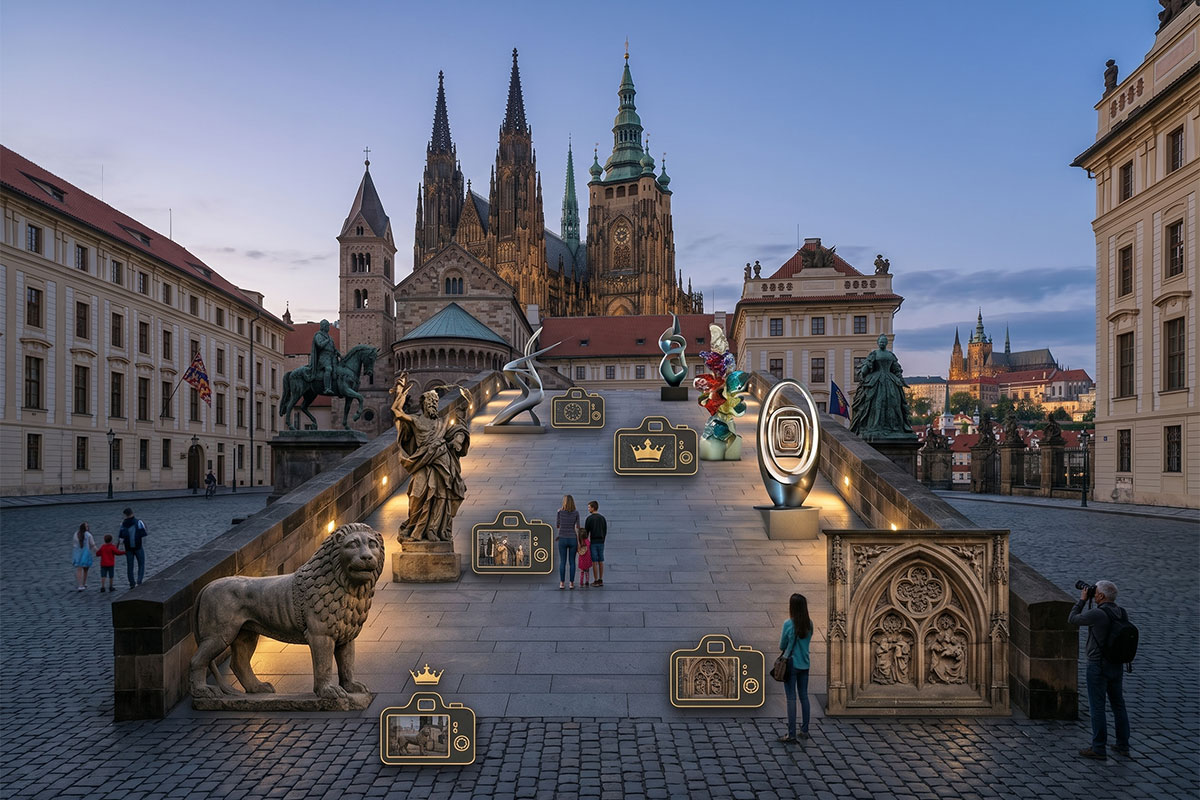
In the Third Courtyard, near the Golden Gate, stands a bronze equestrian statue that many visitors use merely as a foreground for their photos. This is the Statue of St. George Fighting the Dragon, and it is a masterpiece of Gothic metalworking. Created in 1373 by the brothers Martin and George of Cluj, the statue is remarkable for its dynamic composition and detail, which was incredibly advanced for the 14th century. The original statue has been moved to the museum for preservation, but the copy standing in the courtyard is faithful in every regard.
The sculpture captures the moment of tension before the strike. The horse is reared back, its muscles straining, the dragon is writhing beneath, its scales glinting in the sunlight, and the knight is poised with intent, his lance ready to pierce the beast's heart. Historically, this piece is significant because it represents a move away from the static, columnar figures of the early Middle Ages toward the naturalism that would eventually blossom into the Renaissance. It is one of the few free-standing bronze statues from this period surviving in Northern Europe. Take a moment to walk around it and appreciate the anatomy of the horse and the detailing of the knight's armor, which gives insights into the military equipment of the era.
The Powder Tower: A Gothic Gateway to the Past
While technically not *inside* Prague Castle, the Powder Tower (Prašná brána) is an integral part of the castle's history and artistic narrative. Located just outside the castle walls, it served as the main entrance to the Old Town during the reign of King Vladislav II. Built in the late 15th century, the tower is a stunning example of late Gothic architecture, showcasing intricate sculptural details and symbolic ornamentation.
The tower's facade is adorned with statues of kings, saints, and allegorical figures, each meticulously carved from sandstone. Look closely at the details of their clothing and expressions; they offer a glimpse into the artistic sensibilities of the late Middle Ages. The Powder Tower also provides breathtaking panoramic views of Prague, making it a worthwhile stop for any art lover visiting the castle.
Artistic Timeline of Prague Castle
To help you contextualize the art you are seeing, the following table breaks down the key eras and their corresponding hidden gems within the castle complex.
| Art Historical Era | Key Artwork/Feature | Location | Primary Characteristic |
| Gothic (14th Century) | The Last Judgment Mosaic | Golden Gate (Exterior) | Byzantine influence, gold background, Venetian glass. |
| Gothic (14th Century) | St. Wenceslas Chapel Walls | St. Vitus Cathedral | Incrustation with semi-precious stones (Jasper, Amethyst). |
| Gothic (Late 15th Century) | Powder Tower Sculptures | Outside Castle Walls | Detailed sandstone carvings, symbolic ornamentation. |
| Renaissance/Mannerism (16th Century) | Rudolphine Collections | Picture Gallery | Intellectual depth, complex allegories, focus on human form. |
| Art Nouveau (20th Century) | Mucha Stained Glass Window | St. Vitus Cathedral (North Nave) | Vivid colors, Slavic nationalism, painted glass technique. |
Why These Details Matter
Exploring Prague Castle is not just about checking a major landmark off your bucket list; it is about witnessing the endurance of human creativity through times of plague, war, and political change. The artworks listed here—from the fragile glass of the Mucha window to the sturdy bronze of St. George—tell the story of a nation that has always placed a high value on beauty and craftsmanship. By seeking out these lesser-known masterpieces, you engage with the history of Prague in a way that is personal and profound.
As you walk through the courtyards in the crisp air of January 2026, remember to look up, look down, and look closer. The true magic of Prague Castle often lies in the details that others walk past. Whether it is the glimmer of a mosaic tile or the brushstroke of a Renaissance master, these hidden gems are waiting to be discovered by those willing to pause and appreciate them.