A deep dive into the design evolution of Prague Castle, analyzing the interplay of Gothic, Renaissance, and Baroque styles that turn this fortress into a living canvas of art history.
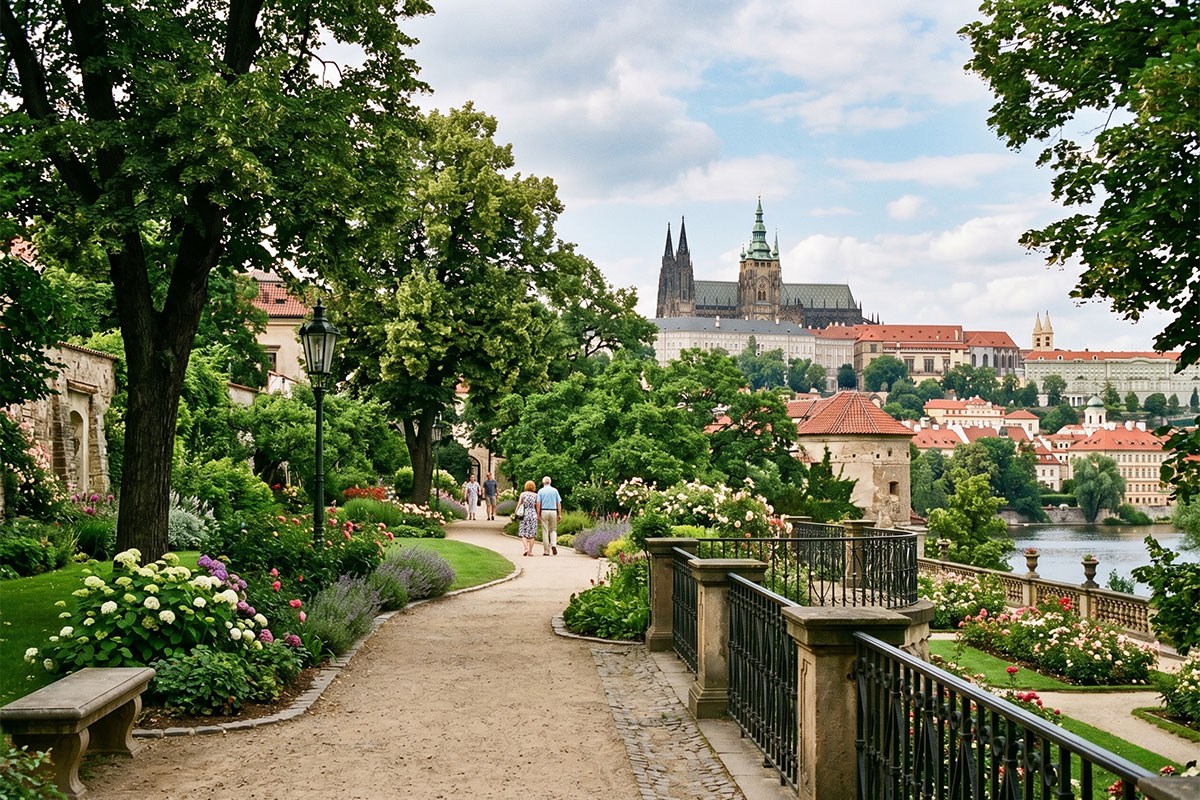
When you stand on the banks of the Vltava River and gaze upward, the silhouette that dominates the skyline is not merely a fortress; it is a sprawling canvas that has been painted over for more than a thousand years. Prague Castle is often cited for its size, holding the title of the largest ancient castle complex in the world, but for the discerning traveler and art enthusiast, its true value lies in its architectural diversity. It is a physical manifestation of European art history, where the austere lines of the Romanesque period hold hands with the flamboyant curves of the Baroque, and the soaring verticality of the Gothic style pierces the sky. To walk through these courtyards in January 2026 is to walk through a masterclass in design, observing how different eras solved the eternal problems of light, space, and gravity with increasing artistic sophistication. Have you ever considered how the architects of different eras would approach the same design challenge?
The Gothic Soul: St. Vitus Cathedral as a Sculptural Masterpiece
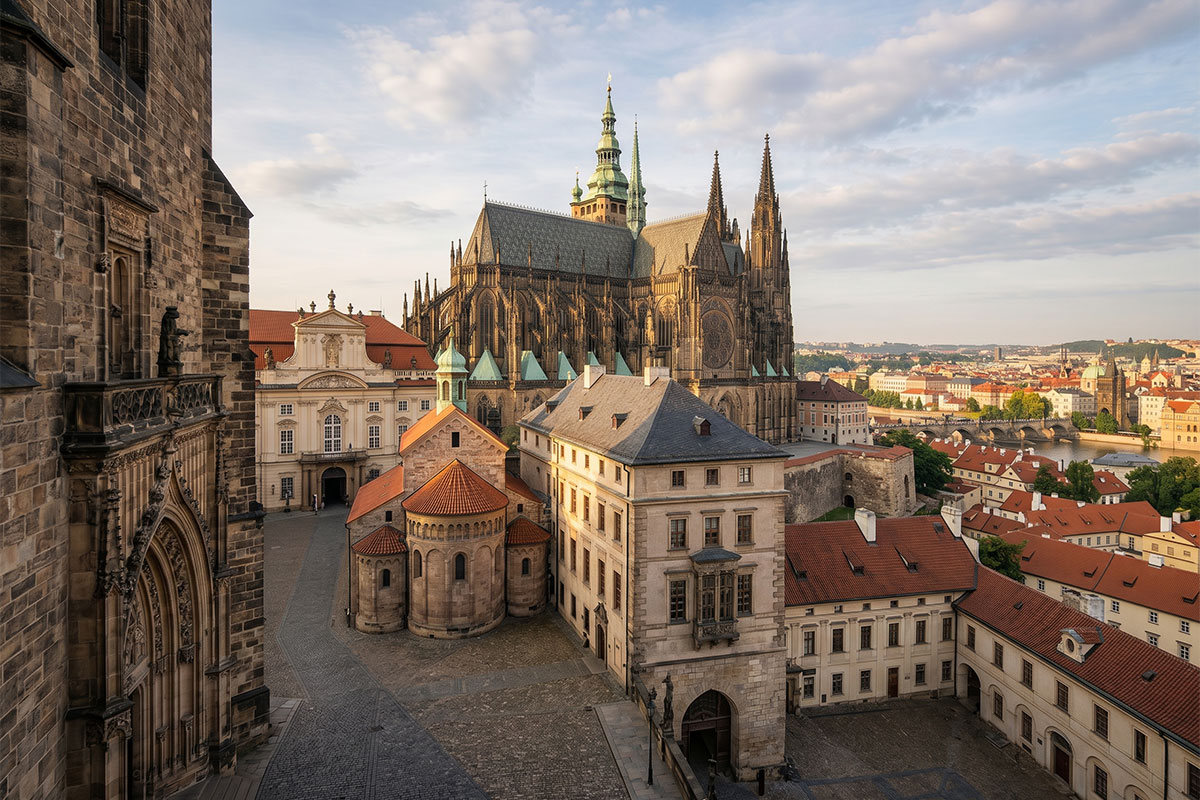
The heart of the castle complex, and arguably its most artistically significant structure, is St. Vitus Cathedral. From an artistic perspective, this is not just a place of worship but a triumph of the High Gothic style, initiated by Matthias of Arras and continued by the visionary Peter Parler. The exterior architecture functions as a stone skeleton; the flying buttresses are not hidden structural necessities but are celebrated as aesthetic elements that allow the walls to dissolve into glass. The gargoyles perched high above are not identical; each is a unique sculpture, a grotesque character study carved with humor and terror in equal measure, designed to ward off evil while channeling rainwater away from the delicate stone.
The Alchemical Play of Light
Stepping inside the cathedral reveals the true artistic intent of Gothic architecture: the manipulation of light to create a spiritual atmosphere. Unlike the dark, heavy interiors of the Romanesque period, St. Vitus is defined by its luminosity. The stained glass windows are not merely decorative; they are narrative paintings made of light. Of particular note is the window designed by Alfons Mucha in the 20th century. His Art Nouveau influence brings a distinctively Czech artistic flair to the medieval structure, using cool blues and warm oranges to depict the origins of Christianity in the Slavic lands. The way the light filters through these panes changes throughout the day, constantly repainting the limestone pillars in shifting hues.
The Transition to Humanism: Renaissance Geometry
As you move from the cathedral to the Old Royal Palace, the architectural language shifts dramatically. The Vladislav Hall is a stunning example of the transition from Late Gothic to the Renaissance. Here, the architect Benedikt Rejt created a vaulted ceiling that defies simple categorization. The ribs of the vault do not follow a simple structural logic; instead, they curve and intertwine like dry branches or the petals of a complex flower. This is structural engineering elevated to pure art, creating a ceiling that feels weightless and organic. The large rectangular windows, a novelty at the time, flooded the hall with natural light, signaling the arrival of Renaissance humanism where clarity and connection to the outside world became paramount.
Just a short walk away, the Royal Summer Palace (Belvedere) offers the purest expression of the Italian Renaissance north of the Alps. The artistic focus here is on:
- Symmetry and Proportion: Unlike the organic growth of the Gothic cathedral, the Belvedere relies on mathematical harmony and rational spacing.
- The Singing Fountain: A masterpiece of bell-metal casting that combines auditory art with visual sculpture.
- Arcades and Reliefs: The delicate stone arcades create a rhythmic play of shadow and light, while the mythological reliefs celebrate human beauty and classical history.
Baroque Theatrics and Romanesque Foundations
The castle complex also serves as a study in contrasts. St. George’s Basilica presents a fascinating artistic dichotomy. Its façade is a brilliant, striking red from the Baroque era, designed to catch the eye and evoke emotion with its dramatic curves and statues. However, once you cross the threshold, the art style strips back to the Romanesque era. The interior is solemn, heavy, and grounded, utilizing thick limestone blocks and rounded arches. This juxtaposition allows the observer to feel the shift in artistic philosophy—from the medieval focus on protection and solidity to the Baroque obsession with theatricality and external appearance. Can you sense the weight of history as you step from the vibrant Baroque facade into the somber Romanesque interior?
Architectural Styles at a Glance
To better understand the complex layering of the castle, we can categorize the key structures by their dominant artistic influence and the design philosophy they represent:
| Architectural Style | Key Structure | Artistic Philosophy | Key Design Element |
| Romanesque | St. George's Basilica (Interior) | Solidity, permanence, defense | Thick walls, rounded arches, small windows |
| Gothic | St. Vitus Cathedral | Verticality, light, spiritual aspiration | Pointed arches, ribbed vaults, flying buttresses |
| Renaissance | Queen Anne's Summer Palace | Humanism, symmetry, perspective | Sgraffito, arcades, mathematical proportion |
| Baroque | Theresian Wing / Facades | Drama, emotion, movement | Curved lines, pastel colors, elaborate stucco |
The Golden Lane: Color and Scale as Narrative
Architecture is not always about grandeur; sometimes, it is about the intimacy of scale. The Golden Lane offers a completely different artistic perspective. These diminutive houses, originally built for castle guards and later inhabited by goldsmiths, utilize color as their primary artistic expression. The bright blues, yellows, and greens of the façades create a storybook atmosphere that contrasts sharply with the imposing grey stone of the nearby towers. From a design standpoint, the challenge here was utilizing minimal space effectively. The low doorways and tiny windows force the visitor to physically adapt to the architecture, creating an immersive experience that feels more like walking through a painting than a street.
The Unification of Diversity
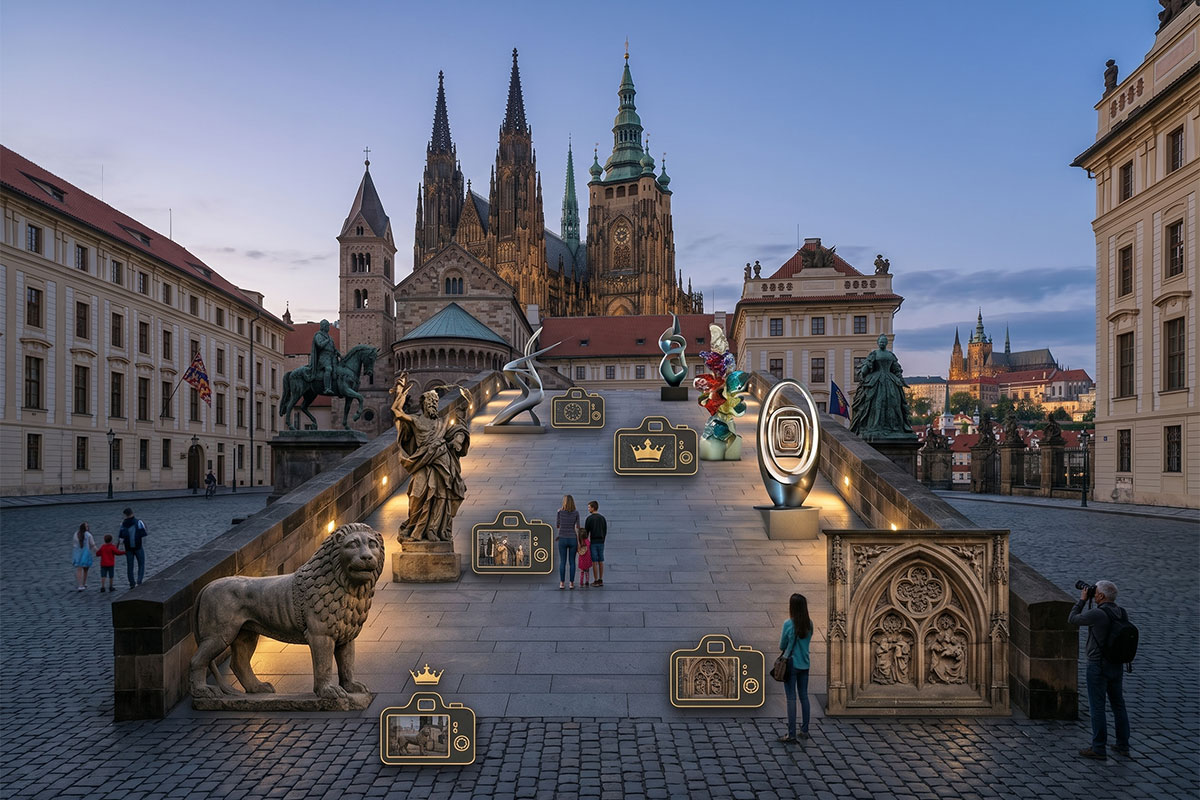
What makes Prague Castle a true marvel is not just the presence of these individual styles, but how they have been stitched together into a cohesive whole. The final major architectural intervention by Maria Theresa in the 18th century, and later by Josip Plečnik in the 20th century, focused on unifying these disparate elements. Plečnik’s contributions, in particular, are subtle modern masterpieces. His use of monoliths, simple geometric forms, and the integration of the gardens into the architectural flow demonstrates how modern design can respect history without mimicking it. He treated the castle grounds as a landscape painting, placing obelisks and bowls to guide the eye and create focal points within the vast courtyards.
Visiting Prague Castle is an exercise in visual literacy. It requires looking beyond the sheer scale of the walls to appreciate the chisel marks on a gargoyle, the geometric perfection of a Renaissance window, or the dramatic shadow cast by a Baroque statue. It is a testament to the enduring power of architecture to tell the story of a nation, capturing the artistic spirit of centuries in stone and glass.