An in-depth exploration of the Bohemian Crown Jewels housed within Prague Castle, detailing their rich history, exquisite craftsmanship, and the fascinating legends that surround these rare symbols of Czech statehood.
When you step into the sprawling complex of Prague Castle, you are not merely entering a tourist attraction; you are walking into the beating heart of Czech history. High above the Vltava River, amidst the Gothic spires of St. Vitus Cathedral, lies a treasure so significant that it is kept under seven locks, hidden away from the world for years at a time. The Bohemian Crown Jewels are more than just gold and gemstones; they are the ultimate symbols of statehood, power, and a spiritual connection to the patron saint of the land. Unlike other European regalia that are permanently on display, the elusive nature of these artifacts adds a layer of mystery and reverence that captivates historians and travelers alike.
The collection comprises the St. Wenceslas Crown, the Royal Scepter, the Imperial Orb, the coronation vestments, and a gold reliquary cross. Each piece tells a distinct story of the era in which it was forged, reflecting the artistic zenith of Central Europe. To understand the weight of these items, one must delve into the vision of Charles IV, the Holy Roman Emperor who elevated Prague to the center of the world in the 14th century. These are not merely decorative accessories; they were legally and spiritually bound to the land itself, making them some of the most historically charged objects in existence.
The Crown of Saint Wenceslas: A Gothic Masterpiece
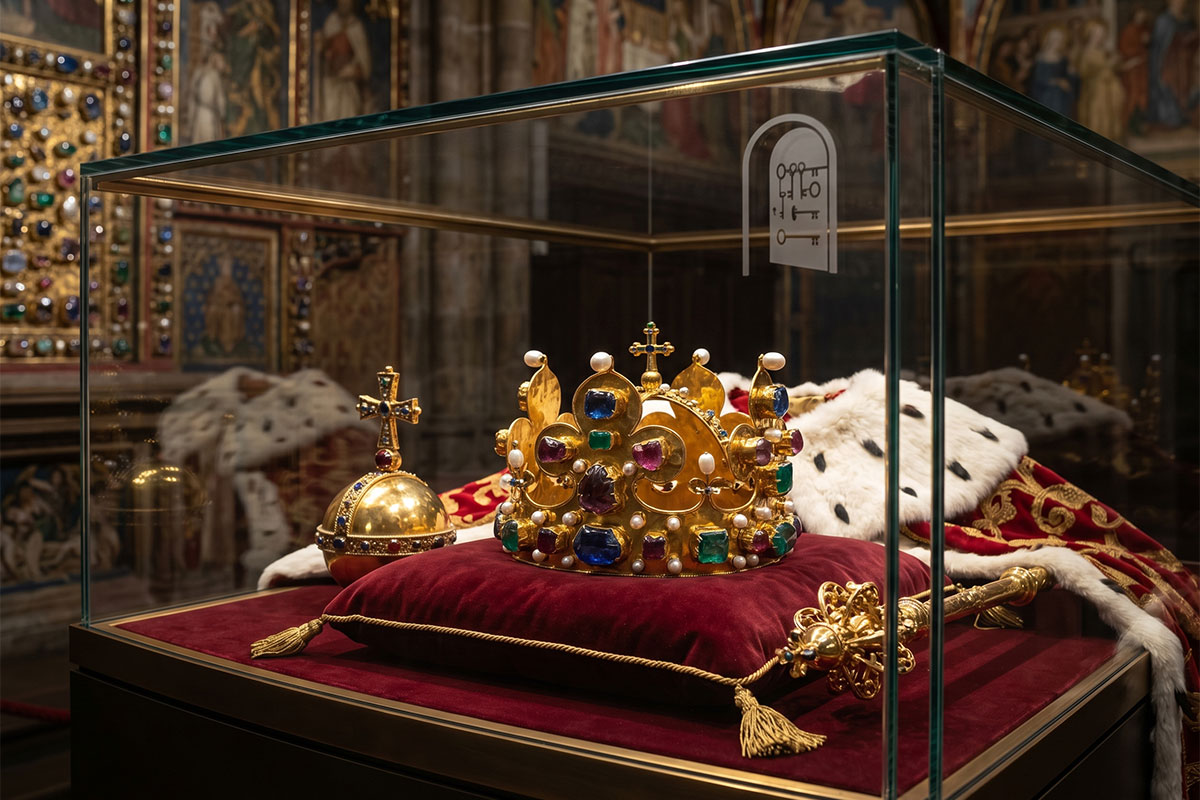
The centerpiece of the collection is undoubtedly the St. Wenceslas Crown, commissioned by Charles IV in 1346 for his coronation as King of Bohemia. Unlike the polished, symmetrical jewelry of modern times, this crown possesses a raw, magnetic beauty. It is crafted from extremely pure gold (21 to 22 carats) and adorned with precious stones that were left in their natural, unpolished forms. This decision was intentional; the Emperor believed that cutting the stones would diminish their power. The crown features 19 sapphires, 44 spinels, 1 ruby, 30 emeralds, and 20 pearls, creating a kaleidoscope of color that glows with an inner fire under the cathedral lights.
The design consists of four fleur-de-lis elements connected by a headband, topped with two arches that intersect to support a golden cross. Inside this cross, according to medieval records, lies a thorn from the Crown of Thorns worn by Jesus Christ. This relic transformed the crown from a mere symbol of royalty into a sacred reliquary. By dedicating the crown to St. Wenceslas, the patron saint of Bohemia, Charles IV ensured that the crown belonged not to the king, but to the saint himself. The monarch was merely borrowing it for the day of his coronation and was obligated to return it to the skull of St. Wenceslas in the cathedral by evening, a ritual that underscored the divine limitation of earthly power.
The Legend of the Curse
The mystique of the St. Wenceslas Crown is deepened by a chilling legend that has persisted for centuries. It is said that any usurper who places the crown on his head without the right to do so will die within a year. This story gained grim traction during World War II. According to the tale, Reinhard Heydrich, the ruthless Nazi Reichsprotektor, secretly placed the crown on his head in 1941 as a gesture of mocking dominance over the Czech people. Some accounts suggest he even wore it during a clandestine meeting, reveling in his perceived power. Whether fact or folklore, the timing remains eerie: Heydrich was assassinated by Czech resistance fighters less than a year later. This legend serves as a powerful narrative shield, reinforcing the idea that the jewels are divinely protected guardians of Czech sovereignty. Further adding to the legend, some believe that the curse extends beyond death, bringing misfortune and hardship to the land should the crown be treated with disrespect or fall into the wrong hands.
The Renaissance Additions: Scepter and Orb
While the crown is a Gothic relic, the Royal Scepter and the Imperial Orb date back to a later period, crafted during the 16th century. These pieces reflect the shift in artistic sensibilities from the raw mysticism of the Middle Ages to the refined, detailed craftsmanship of the Renaissance. Commissioned by Ferdinand I, these items display intricate goldsmithing techniques, including delicate engravings and enamel work that mimics the texture of silk and embroidery.
The Imperial Orb is particularly fascinating due to its complex iconography. Crafted from 18-carat gold, it features scenes from the Old Testament and the life of King David, symbolizing the monarch's role as a wise and just ruler appointed by God. The Royal Scepter, measuring 67 centimeters, is a triumph of balance and beauty, adorned with spinels, pearls, and sapphires. Although they were not part of the original set used by Charles IV, they have become inseparable from the crown over the centuries, completing the visual language of the Bohemian monarchy.
Technical Specifications of the Regalia
To appreciate the sheer physical magnitude of these treasures, it is helpful to look at their composition. The following table outlines the key characteristics of the three main components of the Bohemian Crown Jewels:
| Item | Date of Origin | Material & Weight | Key Features |
| St. Wenceslas Crown | 1346 (Gothic) | 22-carat Gold, 2,358g | 96 precious stones (uncut), 20 pearls, Relic of the True Cross. |
| Royal Scepter | 1533 (Renaissance) | 18-carat Gold, 1,013g | Adorned with 4 sapphires, 5 spinels, 62 pearls; intricate chasing work. |
| Imperial Orb | 1527 (Renaissance) | 18-carat Gold, 780g | Topped with a cross; features relief scenes from Genesis and the life of David. |
The Chamber of Seven Locks
Perhaps the most cinematic aspect of the Bohemian Crown Jewels is the security protocol that protects them. They are not kept in a museum vault, but in the Crown Chamber within St. Vitus Cathedral, located behind the St. Wenceslas Chapel. The door to this chamber is made of heavy iron and secured by seven different locks. This tradition dates back to the crowning of Leopold II in 1791, symbolizing the collective responsibility of the nation's leaders to safeguard its heritage.
Opening the chamber is a rare and solemn ceremony that requires the simultaneous presence of seven specific keyholders. If even one key is missing, the door remains shut. This ensures that no single individual has control over the treasures. The seven keys are currently held by:
- The President of the Republic
- The Prime Minister
- The Archbishop of Prague
- The Chairman of the Senate
- The Chairman of the Chamber of Deputies
- The Dean of the Metropolitan Chapter of St. Vitus Cathedral
- The Mayor of Prague
The gathering of these seven figures is a significant political and cultural event in the Czech Republic. It usually occurs only during presidential elections, significant anniversaries of the state, or moments of national importance. The clanking of the seven keys in the ancient locks is a sound that resonates with history, signaling a brief moment where the past meets the present.
The Coronation Vestments and The Cross
Often overshadowed by the gold and gemstones, the textile components of the regalia are equally precious. The Royal Mantle, made of luxurious red silk known as 'gros de Tours,' is embroidered with gold thread and lined with ermine. Dating back to the early 17th century, it was worn by kings during the coronation mass. The fabric's preservation is a miracle of conservation, requiring strictly controlled humidity and temperature levels to prevent disintegration. Alongside the mantle is the Gold Reliquary Cross, a piece of immense spiritual value. It is known as the Coronation Cross and is a masterpiece of late Gothic goldsmithing, further emphasizing the divine right of the kings who wielded it.
Viewing the Jewels: A Rare Privilege
For the average traveler visiting Prague in 2026, seeing the original Crown Jewels is not a guarantee. Unlike the Crown Jewels in the Tower of London, the Bohemian set is displayed publicly only on special occasions decided by the President of the Republic. These exhibitions typically take place in the Vladislav Hall of the Old Royal Palace. When they are on display, the queues can wind for hours, a testament to the deep respect the Czech people hold for these symbols.
However, visitors need not be entirely disappointed if the chamber is sealed. An exceptional permanent exhibition exists at the Old Royal Palace, featuring masterfully crafted replicas. These replicas are so precise that they allow visitors to appreciate the details of the goldsmithing and the colors of the stones up close, often better than one could with the originals due to security distances. Exploring the narrative of these jewels offers a profound insight into the Central European soul—a story of sanctity, sovereignty, and the enduring beauty of Bohemian craftsmanship.